DynFrs: An Efficient Framework for Machine Unlearning in Random Forestedit
ICLR 2025 paper on efficient machine unlearning for random forests.
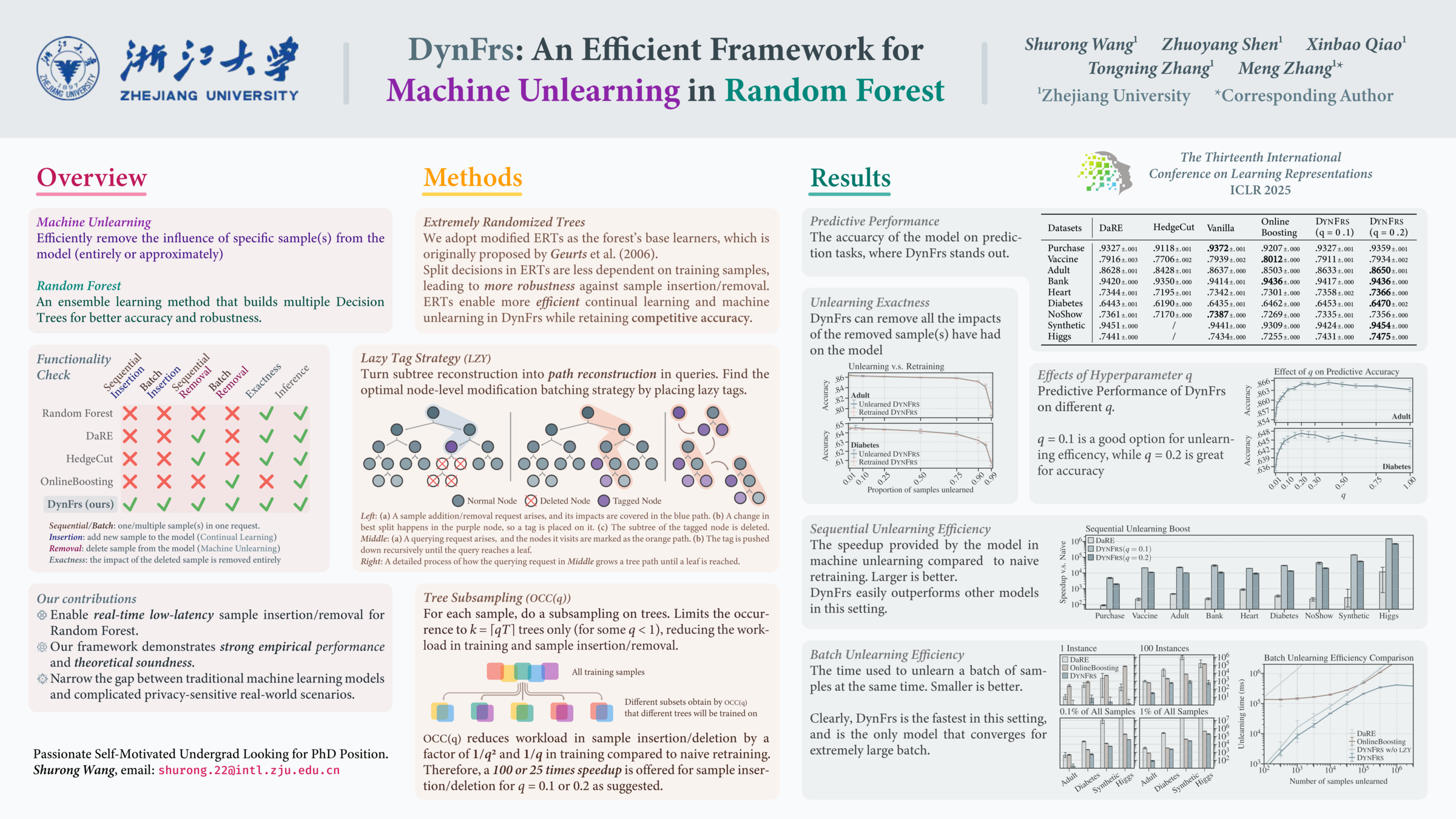
DynFrs: An Efficient Framework for Machine Unlearning in Random Forest is an ICLR 2025 conference paper by Shurong Wang, Zhuoyang Shen, Xinbao Qiao, Tongning Zhang, and Meng Zhang. The work treats random-forest unlearning as a dynamic data-structure problem: it seeks exact distributional equivalence to retraining while keeping online deletion, insertion, and query latency low.
Overviewedit
The paper studies exact and efficient machine unlearning for random forests. Random forests are still widely used in privacy-sensitive domains such as healthcare, finance, and recommendation, but their tree-ensemble structure makes standard gradient-based unlearning tools inapplicable.
DynFrs targets three online operations on a forest: prediction, sample removal, and sample addition. The key design goal is low-latency modification without losing the distributional equivalence required by exact unlearning. The paper therefore treats unlearning as a data-structure and randomized-algorithm problem, not only as a model-update problem.
Methodedit
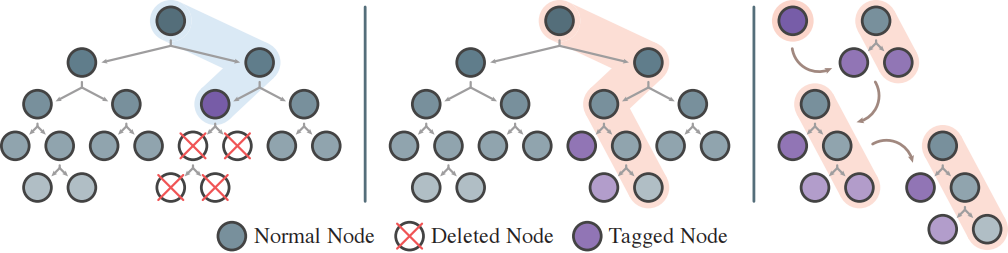
DynFrs combines three mechanisms:
- OCC(q), a tree-subsampling rule that places each training sample in only
ceil(qT)ofTtrees; - LZY, a lazy-tag mechanism that postpones subtree reconstruction until a later query actually traverses the affected path;
- ERT, an Extremely Randomized Tree base learner, chosen because randomized split candidates make the structure less sensitive to local sample changes.
Key takeawaysedit
- Exact unlearning can be a data-structure problem. For random forests, the central challenge is not gradient correction but how to organize tree membership and repair work so that deletion remains equivalent to retraining.
- Latency matters as much as final correctness. A theoretically clean unlearning rule is incomplete if every request blocks prediction or forces broad reconstruction.
- Randomization can make models easier to maintain. By controlling where samples appear and delaying unnecessary subtree work, the framework turns randomness into a maintenance tool rather than only a modeling choice.
- The broader message is that classical models also need lifecycle design. Even non-neural models used in sensitive domains need update paths for deletion, insertion, and continued service.
Resultsedit
The OpenReview paper reports that DynFrs achieves orders-of-magnitude faster unlearning than existing random-forest unlearning methods while preserving or improving predictive accuracy. In the PDF, the authors report a 4000 to 1,500,000 times speedup relative to naive retraining, a 22 to 523 times speedup relative to DaRE in sequential unlearning, and online mixed-stream latency of about 0.12 ms for modification requests and 1.3 ms for querying requests on a large-scale dataset.
The empirical results also distinguish sequential and batch unlearning. DynFrs is presented as the only evaluated random-forest method that remains strong in both settings, because OCC(q) reduces per-sample tree coverage while LZY prevents every deletion from triggering full subtree reconstruction.
Placementedit
This work belongs to Machine Unlearning, Random Forest, and Trustworthy AI. In Qiao's publication record, it complements Hessian-Free Online Certified Unlearning by focusing on exact unlearning for tree ensembles rather than approximate certified unlearning for differentiable models.